
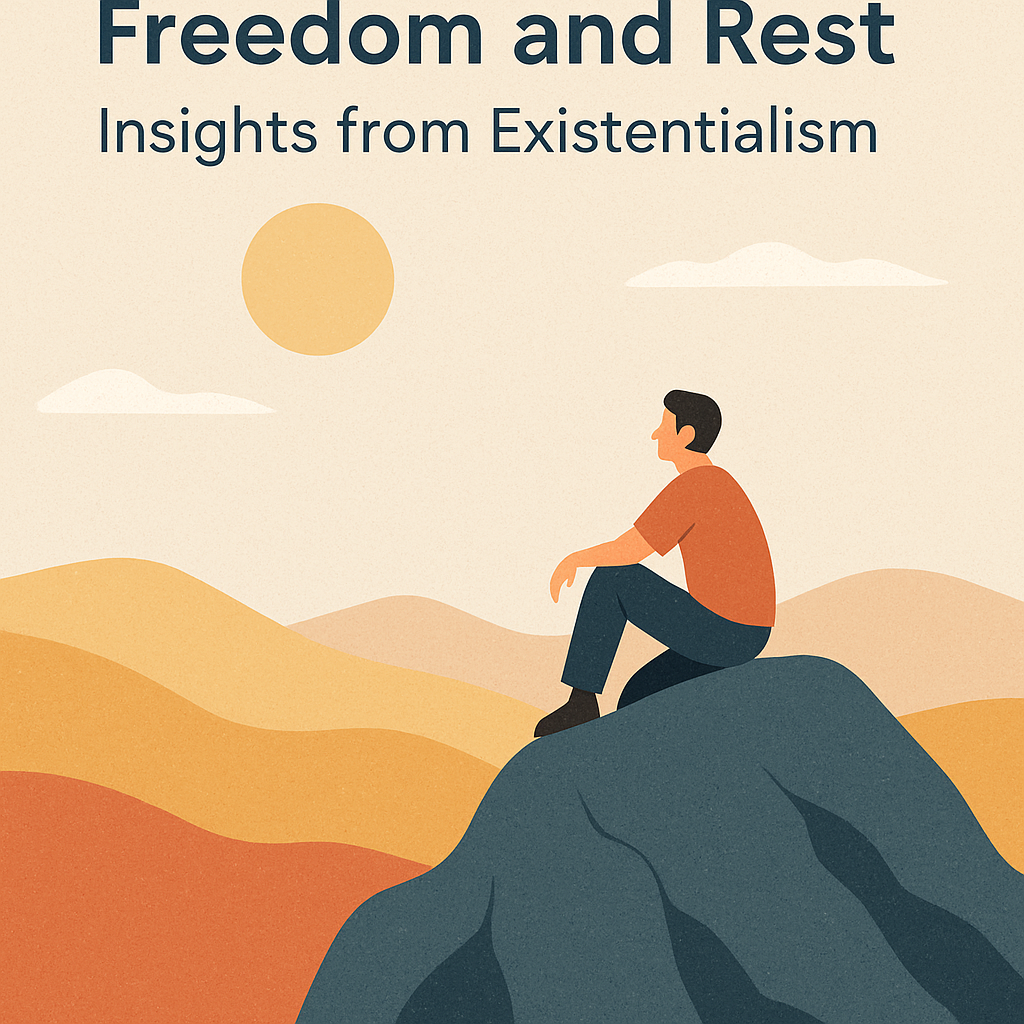
Freedom and Rest: Insights from Existentialism
In modern life, people often equate rest with doing nothing, and freedom with doing whatever they want. Yet, both psychology and existential philosophy remind us that these ideas are far more nuanced.
True freedom is not about unlimited choice, and real rest is not about escape—they are both acts of self-awareness and responsibility.
1. Misconceptions About Freedom and Rest
When we think of rest, we often imagine stillness: lying down, scrolling through a phone, or disconnecting from everything. But these passive forms of rest don’t necessarily restore our energy or bring peace.
Similarly, many view freedom as the ability to act without limits. However, without direction or responsibility, freedom can feel confusing or even overwhelming.
As existential psychologists often remind us: too much freedom without grounding can become chaos; too much structure without freedom can become imprisonment.
2. The Existentialist Perspective
From the existentialist point of view, existence precedes essence—humans are not born with a fixed purpose. We are “thrown into the world” without instructions and must define our meaning through our choices and actions (Sartre, 1943).
This means that choice is the core expression of freedom. Each decision we make reflects who we are becoming. But freedom is not light—it carries the weight of uncertainty and responsibility. We are free to choose, yet also accountable for what those choices create.
3. Freedom and Anxiety
Paradoxically, freedom often brings anxiety. The more possibilities we face, the greater our awareness of what could go wrong. This existential anxiety is not necessarily a flaw—it is the natural tension of being human (Yalom, 1980).
Avoiding freedom may feel safer, but it leads to stagnation and disconnection. Growth requires the courage to face uncertainty, to make imperfect decisions, and to live with their consequences.
True freedom is not about escaping limits, but about embracing them consciously.
4. Rest as an Active Skill
Rest, too, is an active process—an intentional practice of pausing, regulating, and recharging. It allows the mind and body to restore balance so that we can return to life’s responsibilities with clarity and strength.
Existential therapists often view rest as part of self-discipline: learning when to stop, reflect, and recover is essential to navigating freedom wisely.
Structure and rest help transform freedom from chaos into creative power—a rhythm of action and reflection that sustains both productivity and peace.
5. Balancing Freedom and Responsibility
Freedom is not an endpoint—it is a beginning, a space of potential waiting to be shaped by our choices. When we balance freedom with responsibility, and pair action with mindful rest, we cultivate resilience and meaning.
A fulfilling life is not about unlimited options—it’s about consciously shaping the life we already have.
As Rollo May (1983) wrote, “Freedom is the capacity to pause between stimulus and response, and in that pause, to choose.”
References
Sartre, J.-P. (1943). Being and Nothingness. Washington Square Press.
Yalom, I. D. (1980). Existential Psychotherapy. Basic Books.
May, R. (1983). The Discovery of Being: Writings in Existential Psychology. W. W. Norton & Company.
Author: Wendi Jia, LMHC, Psychotherapist at MBG Clinic.
Psychological services available in multiple languages (English, Mandarin, Cantonese, French, Turkish, etc.): 650-434-2563; admin@mindbodygarden.com. HSA/FSA accepted. Send us a text message on the phone, or call us and leave a voicemail.
Appointment & Office Locations:
admin@mindbodygarden.com
Office 1 (Los Altos)
885 N. San Antonio Rd., Suite O, Los Altos, CA 94022
Office 2 (SF)
110 Gough Street #402, San Francisco, CA 94102
Office 3 (San Diego)
9920 Pacific Heights Blvd, Suite 150, San Diego, CA 92121
Office 4 (New York)
303 Fifth Avenue, Suite 901, New York, NY 10016