
Understanding “It’s Okay to Share Family Issues Sometimes”: A Therapist’s Perspective
In many cultures, people are taught that “family matters should not be shared.” This idea is rooted in the value of privacy and protection—keeping family issues inside to maintain dignity and harmony. Yet in therapy, we often see how unspoken pain can silently harm individuals and relationships.
So when is it actually okay—or even healthy—to talk about family issues?
1. Cultural Background
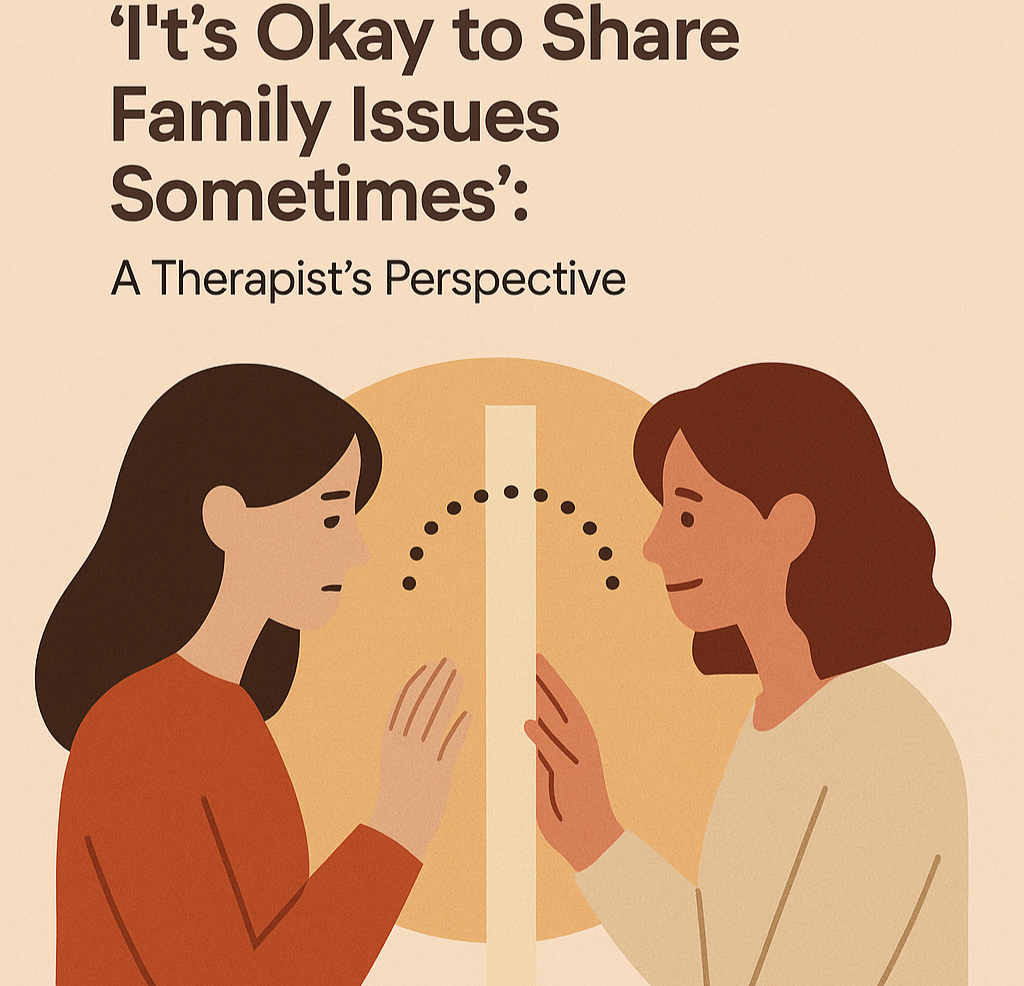
The belief that “family matters should not be shared” serves an important cultural function. It encourages loyalty and protects families from external judgment or shame. For generations, this mindset has helped people survive in tightly knit communities where reputation and social harmony were vital.
However, the same rule that once protected families can, in modern contexts, become a barrier to emotional healing. Silence, when rigidly applied, can prevent individuals from processing pain or seeking help when it’s truly needed.
2. The Cost of Bottling Up Emotions
Keeping distress hidden often comes at a psychological cost. As the proverb says, “An insider may be confused while an outsider sees clearly.”
When we are caught inside emotional turmoil, it becomes difficult to view situations objectively or regulate our feelings effectively.
Avoiding expression or help-seeking can lead to:
Emotional overload: negative feelings build up internally, leading to anxiety or depression.
Isolation: without external feedback, people may feel trapped or misunderstood.
Lost opportunities for support: reaching out for help often leads to insights, relief, and solutions that may not be visible alone.
Psychological research supports this: chronic emotional suppression can intensify stress and reduce psychological flexibility (Linehan, 1993; Neff, 2011).
3. Healthy Boundaries: Openness with Clarity
Healthy boundaries do not mean secrecy or overexposure—they mean discernment. It’s about understanding what to share, with whom, and under what circumstances.
Sharing, when done safely, is not shameful; it’s a form of self-care.
Expressing emotions or seeking help in a safe space (such as therapy, support groups, or trusted relationships) helps transform boundaries from rigid walls into flexible protective networks—strong enough to protect, yet open enough to connect (Siegel, 2012).
4. The Psychological Meaning of “It’s Okay to Share Family Issues”
Saying “it’s okay to share family issues” doesn’t mean airing every private matter publicly. It means recognizing that:
Some problems are too heavy to carry alone.
Emotional suffering deserves attention and support.
Healing often begins with being seen and heard.
By opening up—selectively, appropriately, and safely—we take responsibility for our own well-being. This act of courage not only strengthens personal mental health but can also inspire healthier communication within families.
References
Linehan, M. M. (1993). Cognitive-Behavioral Treatment of Borderline Personality Disorder. Guilford Press.
Neff, K. D. (2011). Self-Compassion: The Proven Power of Being Kind to Yourself. William Morrow.
Siegel, D. J. (2012). The Developing Mind: How Relationships and the Brain Interact to Shape Who We Are. Guilford Press.
Author: Wendi Jia, LMHC, Psychotherapist at MBG Clinic.
Psychological services available in multiple languages (English, Mandarin, Cantonese, French, Turkish, etc.): 650-434-2563; admin@mindbodygarden.com. HSA/FSA accepted. Send us a text message on the phone, or call us and leave a voicemail.
Appointment & Office Locations:
admin@mindbodygarden.com
Office 1 (Los Altos)
885 N. San Antonio Rd., Suite O, Los Altos, CA 94022
Office 2 (SF)
110 Gough Street #402, San Francisco, CA 94102
Office 3 (San Diego)
9920 Pacific Heights Blvd, Suite 150, San Diego, CA 92121
Office 4 (New York)
303 Fifth Avenue, Suite 901, New York, NY 10016